Your lawyer should review your severance package in Ontario
A termination letter can affect thousands of dollars, future benefits, legal claims, references, and the employee’s next steps.
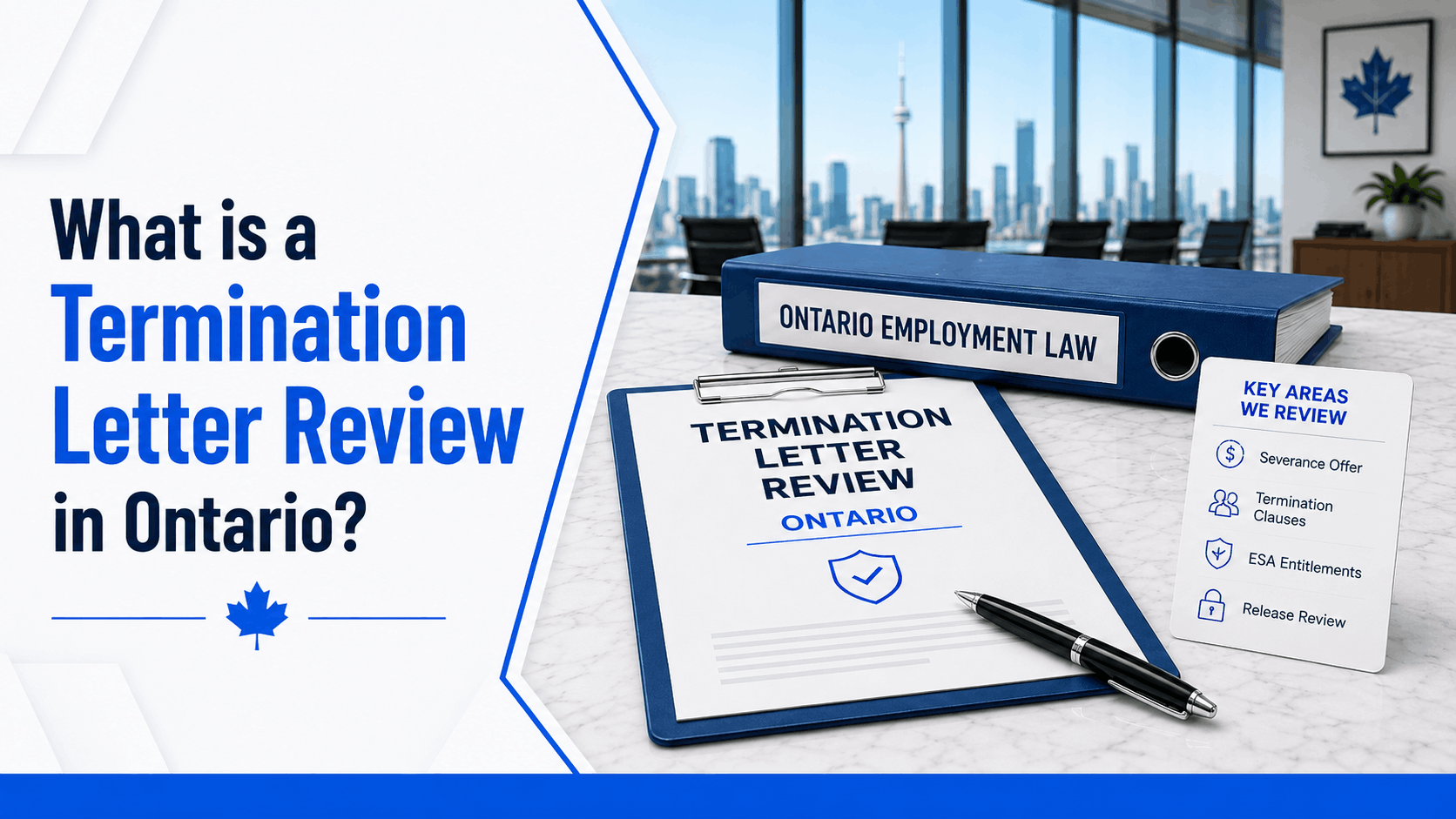
Losing your job can be stressful, confusing, and emotional. When an employer gives you a termination letter, it may feel like the decision is final and there is nothing left to discuss. But in Ontario, a termination letter is not always the end of the story. It is often the starting point for understanding what you are being offered, what your rights may be, and whether the employer has properly handled the termination.
A termination letter review is when a lawyer reviews the letter and related documents to help you understand your situation. This may include the termination letter, your employment contract, any severance offer, a release, benefit information, bonus or commission plans, and emails or policies that affect your employment. The goal is to explain what the employer is offering, what you may be legally entitled to, and whether there are issues worth challenging.
In Ontario, termination rights usually come from more than one place. The first source is the Employment Standards Act, often called the ESA. The ESA sets minimum rules for notice of termination, termination pay, benefit continuation, and severance pay where the employee qualifies. Ontario’s official ESA materials explain that an employee who does not receive the required written notice must receive termination pay instead, and that termination pay is based on the regular wages the employee would have earned during the statutory notice period.
The second source may be the employee’s contract. Many employment contracts include termination clauses that try to limit what the employee receives when the job ends. Some contracts limit the employee to ESA minimums only. Others provide a formula based on years of service. Others are unclear or badly drafted. A termination letter review often needs to compare the termination letter against the employment contract.
The third source is the common law. In Ontario, if there is no enforceable termination clause limiting the employee’s rights, the employee may be entitled to reasonable notice or pay in lieu of notice under the common law. This can sometimes be much more than the ESA minimums. Common law notice depends on factors such as the employee’s age, length of service, position, compensation, and the availability of similar employment.
This is why the wording of the employment contract matters so much. An employer may give a termination letter that assumes the contract limits the employee to ESA minimums. But if the termination clause is unenforceable, the employee may be entitled to more. That is one of the biggest reasons to have the termination letter reviewed before signing anything.
One major Ontario case in this area is Waksdale v. Swegon North America Inc. In that case, the Ontario Court of Appeal dealt with an employment contract where the employer relied on the without-cause termination provision, but another termination provision in the contract was problematic. The result was important because the court treated the termination provisions as a whole, rather than allowing the employer to rely only on the part it wanted. Commentators have explained that Waksdale meant a defective “for cause” termination provision could make a separate “without cause” termination provision unenforceable, even if the employer was not relying on the “for cause” clause at the time of dismissal.
In plain English, Waksdale matters because an employee should not assume the employer’s termination clause is valid just because the letter says so. A contract may look official and confident, but Ontario courts have closely examined termination language. If the wording violates or potentially avoids ESA minimum standards, the clause may fail. That can change the entire value of the termination package.
Termination letters can also be tricky because they often come with deadlines. The employer may ask the employee to sign a release by a certain date in exchange for a severance package. A release is a legal document where the employee usually gives up the right to sue or make further claims against the employer. Once signed, it can be difficult to go back and ask for more. That is why it is important to understand the offer before signing.
A termination letter review can also look at whether the employer is continuing benefits properly. Under Ontario’s ESA rules, termination pay and statutory notice are connected to minimum employment standards, and benefits continuation during the statutory notice period can be an important issue. If a termination letter says benefits end immediately, or does not clearly explain benefits continuation, that may require careful review.
Severance pay is another area where people get confused. In everyday conversation, people often use the word “severance” to mean any money paid after termination. But under the Ontario ESA, “severance pay” has a specific meaning and only applies to employees who meet certain conditions. Ontario’s official guide explains that severance pay is separate from termination pay and applies where the employee qualifies under the ESA’s severance rules.
This means a termination letter might include termination pay, statutory severance pay, common law notice, benefits continuation, vacation pay, bonus treatment, commission payments, or other items. These should not all be lumped together without understanding what they are. A lawyer can help separate the pieces so the employee understands what is actually being offered.
Bonuses and commissions are especially important. Some employees are owed commissions that were earned before termination. Others may have annual bonuses, performance bonuses, stock options, RSUs, profit-sharing, or other incentive compensation. The termination letter may try to cut off those rights. Whether that is allowed depends on the contract, the bonus plan, and the law.
A review can also look at whether the termination is being called “without cause” or “for cause.” A without-cause termination means the employer is ending the relationship even though it is not alleging serious misconduct. A for-cause termination is much more serious because the employer may claim the employee is not entitled to notice or termination pay. In Ontario, just cause can be difficult for employers to prove, and employees should be cautious before accepting that label.
Sometimes termination letters are connected to other workplace issues. For example, the employee may have recently complained about harassment, asked for accommodation, taken medical leave, requested parental leave, raised safety concerns, or complained about unpaid wages. In those situations, the termination may raise issues beyond ordinary notice and severance. A review can help identify whether human rights, reprisal, or other legal issues may be involved.
A termination letter review can also help employees understand whether the offer is practical. Not every issue leads to a lawsuit. Sometimes the best approach is to negotiate a better package. Sometimes it is to ask for corrections, such as benefit continuation, a better reference letter, payment of outstanding wages, or more time to consider the offer. Sometimes the offer is reasonable and the employee simply wants peace of mind before signing.
For employers, termination letters also matter. A poorly drafted termination letter can create confusion, increase legal risk, or accidentally say something that causes problems later. Employers should be careful about how they describe the reason for termination, what payments are being made, what benefits continue, what release is requested, and whether the letter is consistent with the employment contract and ESA.
Flatly.ca offers Termination Letter Review in Ontario for people who want help understanding a termination letter, severance offer, release, or related employment documents before making a decision.
A termination letter can affect thousands of dollars, future benefits, legal claims, references, and the employee’s next steps. Before signing a release or accepting the employer’s position, it is worth slowing down and understanding what the letter really means. In Ontario employment law, small wording details can make a big difference.
Legal Disclaimer
This article is for general information purposes only and does not constitute legal advice. It does not create a lawyer-client relationship. Laws and procedures may change. For advice specific to your situation, consult a licensed Ontario lawyer.
Need help with an Ontario legal matter?
Browse transparent flat-fee packages — know the cost before you commit.
Browse All Services