What is CASL and Why Your Business Needs a Compliance Policy
Federal legislation provides for maximum penalties of up to $1,000,000 for an individual and $10,000,000 for corporations.
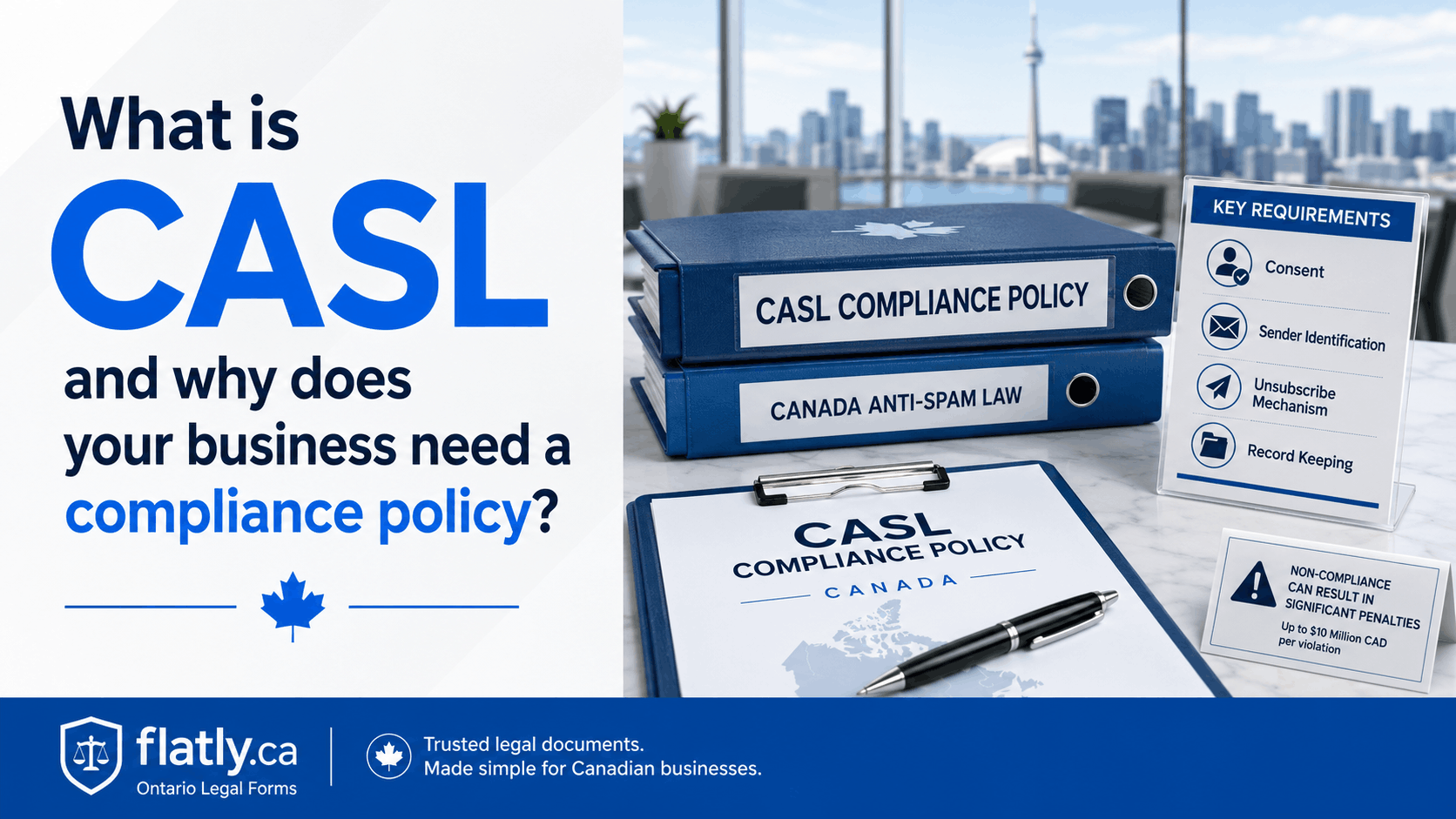
If your business sends marketing emails, text messages, newsletters, promotional messages, sales follow-ups, discount offers, referral requests, event invitations, or other electronic messages to customers or potential customers, you need to understand Canada’s Anti-Spam Legislation, usually called CASL.
CASL is Canada’s federal anti-spam law. It applies to many businesses across Canada, including businesses in Ontario. The law is meant to protect people and businesses from spam, misleading electronic messages, malware, and other online threats. The Government of Canada describes CASL as legislation that protects consumers and businesses from the misuse of digital technology, including spam and other electronic threats.
For most small businesses, the most important part of CASL is the rule about commercial electronic messages, often called CEMs. A commercial electronic message is not just an obvious spam email. It can include many ordinary business messages if one of the purposes of the message is to encourage commercial activity. This can include emails, texts, and certain other electronic messages that promote products, services, events, offers, business opportunities, or customer relationships.
In simple terms, if your business is sending messages to help sell something, promote something, book consultations, generate leads, advertise services, encourage repeat business, or move someone toward becoming a customer, CASL may apply.
The CRTC explains that businesses sending commercial electronic messages must generally do three things: obtain consent, provide identification information, and include an unsubscribe mechanism. These three requirements are the heart of CASL compliance.
The first requirement is consent. You usually need permission before sending someone a commercial electronic message. Consent can be express or implied. Express consent means the person clearly agreed to receive messages. Implied consent may exist in certain situations, such as where there is an existing business relationship, but implied consent has limits and should not be assumed too casually.
This is where many businesses get into trouble. They may collect business cards, scrape emails from websites, buy lead lists, upload old contacts into email software, or message people who made inquiries years ago. But under CASL, the business should be able to explain why it had the legal right to send the message. If you cannot prove consent, you may have a compliance problem.
The second requirement is identification. A commercial electronic message should clearly identify who is sending the message. The recipient should not have to guess who contacted them or how to reach the sender. In practical terms, marketing emails should usually include the business name and proper contact information.
The third requirement is an unsubscribe mechanism. People must be able to stop receiving commercial electronic messages. The unsubscribe process should be clear, simple, and functional. It should not be hidden, confusing, or made intentionally difficult. If someone unsubscribes, the business must have a process for ensuring that person is removed from future marketing messages.
A CASL compliance policy helps your business create internal rules for handling these issues. It can explain how your business collects consent, records consent, manages email lists, writes compliant messages, handles unsubscribe requests, trains staff, uses marketing software, and deals with complaints. The goal is to move your business away from casual guessing and toward a repeatable compliance process.
This matters because CASL can apply to ordinary businesses, not just obvious spammers. A local service business sending promotional emails, a SaaS company sending product updates, a law firm sending newsletters, a real estate professional sending market updates, an online store sending discount codes, a consultant sending sales sequences, or a startup sending launch announcements may all need to think about CASL.
CASL also applies beyond emails sent from inside Canada. The CRTC’s FAQ explains that CASL can apply to commercial electronic messages received in Canada from other countries. That means foreign businesses sending commercial messages to Canadian recipients may also need to comply.
The consequences of non-compliance can be serious. CASL gives regulators the ability to investigate and take enforcement action. The federal CASL performance materials explain that the CRTC is responsible for enforcing key CASL rules involving commercial messages, computer programs, and transmission data, and that the CRTC can set administrative monetary penalties.
The maximum administrative monetary penalties under CASL are significant. The federal legislation provides for maximum penalties of up to $1,000,000 for an individual and $10,000,000 for any other person, such as a corporation. These are maximum amounts, not automatic penalties for every mistake, but they show how seriously the law can treat non-compliance.
There have also been real enforcement actions. For example, the CRTC reported that since CASL came into force in 2014, enforcement efforts had resulted in over $3.2 million issued in administrative monetary penalties as of its 2024 enforcement update. In another enforcement matter, the CRTC reported issuing a notice of violation with a $75,000 administrative monetary penalty to an individual for sending commercial electronic messages without recipient consent.
Non-compliance can also create business problems beyond penalties. If people report your messages as spam, your email deliverability can suffer. Your domain reputation can be damaged. Your marketing software account may be suspended. Customers may lose trust. Business partners may become concerned. Even if no penalty is issued, poor CASL practices can hurt your business.
A good CASL policy should be practical. It should not just say “we comply with CASL.” It should explain how the business actually complies. For example, it may set rules for using opt-in forms, keeping consent records, avoiding purchased email lists, documenting implied consent, reviewing marketing campaigns, including sender information, testing unsubscribe links, and removing unsubscribed users from lists.
It should also address staff behaviour. Many CASL risks happen because someone on the team does something without thinking. A salesperson may upload a spreadsheet of contacts. A marketing assistant may use an old list. A contractor may send cold outreach. A founder may import LinkedIn contacts into an email tool. A clear policy helps everyone understand what is allowed before a problem happens.
For Ontario businesses, CASL compliance is especially important because many companies rely heavily on digital marketing. Whether you run a professional service firm, online platform, local service business, ecommerce store, SaaS business, coaching business, real estate service, agency, or startup, your growth strategy may involve electronic messages. If those messages are commercial, CASL should be part of your legal planning.
A CASL compliance policy can also work together with your Privacy Policy and Terms of Service. Your Privacy Policy explains how you collect and use personal information. Your Terms of Service sets rules for users of your website or platform. Your CASL policy helps govern how your business sends commercial electronic messages and manages consent. Together, these documents can make your business look more organized and reduce avoidable legal risk.
Flatly.ca offers CASL Compliance Policy drafting in Ontario for businesses that want clearer internal rules for commercial electronic messages, consent, unsubscribe practices, and electronic marketing compliance.
CASL is not something businesses should ignore simply because “everyone sends marketing emails.” The law applies to real-world marketing activity, and the consequences of getting it wrong can be serious. A clear CASL compliance policy can help your business send messages more carefully, protect its reputation, and reduce the risk of costly compliance problems.
Legal Disclaimer
This article is for general information purposes only and does not constitute legal advice. It does not create a lawyer-client relationship. Laws and procedures may change. For advice specific to your situation, consult a licensed Ontario lawyer.
Need help with an Ontario legal matter?
Browse transparent flat-fee packages — know the cost before you commit.
Browse All Services