Why your Ontario business needs a Master Service Agreement
A Master Service Agreement is not about making a business relationship more complicated. It is about making the relationship clearer.
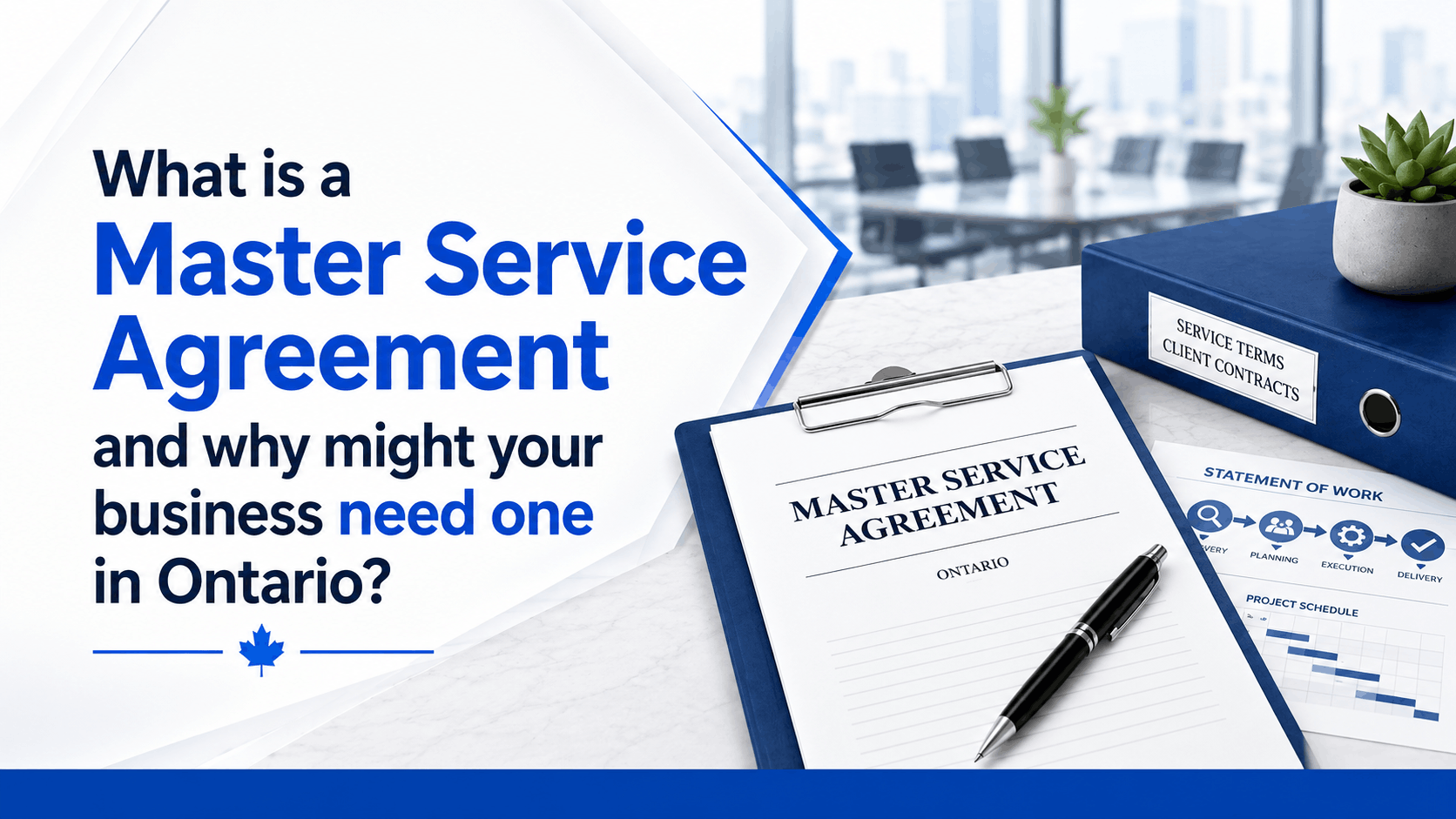
A Master Service Agreement, often called an MSA, is a contract that sets the main rules for an ongoing business relationship. Instead of writing a brand-new contract every time one business provides services to another, the parties can use one main agreement that governs the relationship over time.
In simple terms, an MSA is like the rulebook for future work. It explains the general terms that apply whenever services are provided. Then, for each specific project, the parties can use a shorter document, often called a statement of work, work order, proposal, or service schedule. That shorter document can describe the specific services, price, timeline, deliverables, and project details.
For example, imagine a marketing agency does ongoing work for a client. One month, the agency may build a landing page. The next month, it may run ads. Later, it may create social media content or redesign part of the client’s website. Instead of signing a completely new contract every time, the agency and client can have one Master Service Agreement that applies to all of those projects, with separate statements of work for each job.
This can make business relationships much easier to manage. The MSA can cover the legal and business terms that do not need to change every time. These may include payment terms, late fees, confidentiality, intellectual property ownership, termination rights, limits of liability, dispute resolution, warranties, and what happens if one side does not perform.
One major benefit of an MSA is clarity. When the relationship starts, everyone may be friendly and excited to work together. But if something goes wrong, people often remember the deal differently. The client may think unlimited revisions were included. The service provider may think only one round of revisions was included. The client may expect ownership of all files immediately. The service provider may expect payment first. A clear MSA helps avoid these arguments by setting the expectations in writing.
Another important issue is payment. A Master Service Agreement can explain when invoices are issued, when payment is due, whether deposits are required, what happens if payment is late, and whether work can pause if invoices are not paid. This is especially important for service providers who do not want to keep working for a client who is already behind on payment.
An MSA can also deal with scope creep. Scope creep happens when a project slowly grows beyond what was originally agreed. A client may ask for “just one more thing,” then another, then another. Without clear rules, the service provider may feel pressured to do extra work for free. A good MSA can say that extra work requires approval, may require a new quote, and may result in additional fees.
Intellectual property is another key part of many MSAs. If a designer creates a logo, a developer writes code, a consultant prepares materials, or a writer creates content, the agreement should explain who owns the work and when ownership transfers. Some businesses transfer ownership only after full payment is received. Others license certain materials while keeping ownership of templates, tools, systems, or background materials.
Confidentiality can also be important. During a service relationship, one business may receive access to private information, such as customer lists, passwords, financial records, marketing strategies, trade secrets, pricing, or internal processes. An MSA can require both sides to protect confidential information and use it only for the purpose of the business relationship.
A Master Service Agreement can also limit risk. Many service providers include limits of liability to reduce the chance that one mistake leads to a massive claim far beyond the value of the contract. These clauses need to be drafted carefully, but they can be important for businesses that provide professional, creative, technical, marketing, consulting, or operational services.
The agreement can also explain how the relationship ends. For example, can either side terminate on written notice? Can the service provider terminate if invoices are unpaid? What happens to unfinished work? Does the client still have to pay for work already completed? What happens to confidential information, accounts, files, and access credentials after termination? These are easier questions to answer before the relationship breaks down.
MSAs are useful for many types of businesses. They can help consultants, marketing agencies, software developers, designers, contractors, fractional executives, virtual assistants, accountants, business coaches, IT providers, operations consultants, and other service-based businesses. They can also help clients who regularly hire service providers and want consistent rules across projects.
A Master Service Agreement is not just for large companies. Small businesses can benefit from MSAs because they often rely heavily on cash flow, trust, and repeat relationships. A clear agreement can make the business look more professional and reduce the chance of confusion.
That said, an MSA should not be treated like a random internet template. A template may not match your business, your services, your payment model, your risk level, or Ontario law. It may be too vague, too aggressive, too weak, or missing important clauses. A proper MSA should reflect how the business actually works.
Flatly.ca offers Master Service Agreement drafting in Ontario for businesses that want clear, practical contract terms for ongoing service relationships. This can help business owners set expectations, protect payment rights, manage project scope, and reduce avoidable disputes.
A Master Service Agreement is not about making a business relationship more complicated. It is about making the relationship clearer. When both sides understand the rules from the beginning, it becomes easier to focus on the work instead of arguing later about what was supposed to happen.
Legal Disclaimer
This article is for general information purposes only and does not constitute legal advice. It does not create a lawyer-client relationship. Laws and procedures may change. For advice specific to your situation, consult a licensed Ontario lawyer.
Need help with an Ontario legal matter?
Browse transparent flat-fee packages — know the cost before you commit.
Browse All Services