A lawyer must review your Separation Agreement in Ontario
A separation agreement can help people resolve family law issues without going to court, but it must be taken seriously.
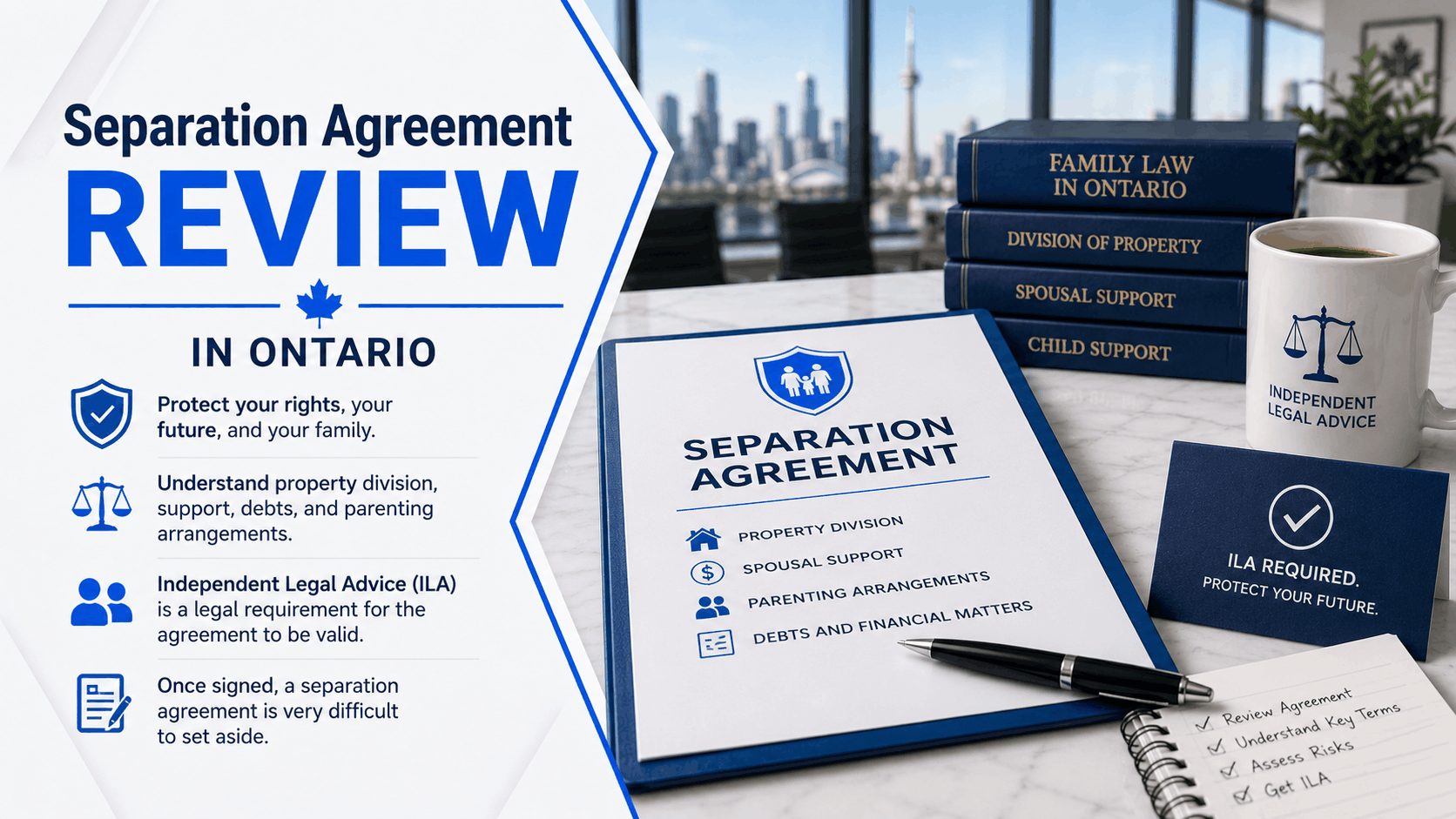
A separation agreement is one of the most important legal documents a person may ever sign. It can decide major issues such as how property is divided, how debts are handled, whether spousal support will be paid, and what parenting arrangements will look like after separation.
In Ontario, a separation agreement is a type of domestic contract. It is usually used by spouses or partners who are separating and want to settle their family law issues without having a judge decide everything for them. A well-prepared agreement can create structure, reduce conflict, and help both people move forward with more certainty.
But a separation agreement is also serious. Once it is signed, it can be very difficult to change or set aside. That is why it should not be treated like a simple form or casual agreement. If the terms are unfair, unclear, incomplete, or based on poor financial disclosure, the consequences can last for years.
A separation agreement may deal with property division. For married spouses in Ontario, this often involves issues such as the matrimonial home, bank accounts, investments, pensions, vehicles, businesses, debts, and equalization of net family property. Ontario’s official family law materials explain that property division can involve what each spouse owns, what each spouse owes, and what support may be payable when a marriage or common law relationship ends.
A separation agreement may also deal with debts. This can include mortgages, lines of credit, credit cards, personal loans, tax debts, business debts, or debts owed to family members. Debt clauses matter because one person may assume that the other person is responsible for a debt, but the lender may still expect payment from whoever legally owes it. A separation agreement can create obligations between the spouses, but it does not always change the rights of third-party creditors.
Spousal support is another major issue. A separation agreement may say whether support will be paid, how much will be paid, how long it will continue, when it can be reviewed, and when it may end. Support terms should be drafted carefully because vague wording can create future conflict. The agreement should also make clear whether support is meant to be final, reviewable, variable, or tied to specific events.
If the parties have children, a separation agreement may also deal with parenting arrangements. This can include decision-making responsibility, parenting time, holidays, school issues, travel, communication, exchanges, and other practical parenting details. The federal Department of Justice describes a parenting plan as a written document that outlines how parents will raise their children after separation or divorce.
Child support may also be addressed. Child support is different from spousal support because it is the right of the child. Parents generally cannot simply agree that no child support will be paid if the law requires support. A separation agreement should be careful about income, parenting time, table support, special or extraordinary expenses, and how support will be updated over time.
A separation agreement review is when a lawyer reviews a proposed agreement before you sign it. The goal is to help you understand what the document says, what rights you may be giving up, what obligations you are accepting, and whether any parts of the agreement create risk. It is not just a grammar check. It is a legal review of a document that may affect your home, money, children, future income, and legal rights.
Independent Legal Advice, often called ILA, is especially important. Legal Aid Ontario explains that while people can draft their own separation agreement, they should have a lawyer review it before signing, and that this is called independent legal advice. Legal Aid Ontario also says the agreement should be signed in front of a witness, who also signs.
Under Ontario’s Family Law Act, a domestic contract must be in writing, signed by the parties, and witnessed. The Act also says a court may set aside a domestic contract or part of one in certain situations, including where a party failed to disclose significant assets, debts, or liabilities, where a party did not understand the nature or consequences of the contract, or otherwise in accordance with the law of contract.
This is why financial disclosure matters so much. Before signing a separation agreement, both sides should usually exchange proper information about income, assets, debts, pensions, business interests, real estate, investments, and other financial issues. If one person signs without knowing the true financial picture, the agreement may be vulnerable to challenge later.
Independent Legal Advice also helps show that each person understood what they were signing. A lawyer can explain the agreement in plain English, identify concerns, discuss alternatives, and confirm whether the person appears to understand the legal consequences. This can help reduce the risk of one party later saying they signed under pressure, did not understand the agreement, or did not know what rights they were giving up.
A review can also identify unfair or unclear terms. For example, a property clause may not explain how a pension is being valued. A debt clause may not deal with joint credit cards. A support clause may not say whether support can be changed if income changes. A parenting clause may not deal with holidays or travel. A release clause may be too broad. Small drafting problems can turn into large disputes later.
It is also important to understand that a separation agreement review is different from negotiating a full agreement from scratch. In a review, a lawyer is usually looking at a proposed document and explaining the risks, concerns, and legal meaning of the terms. Depending on the service, the lawyer may also provide comments, suggest changes, or advise whether further negotiation is needed before signing.
People sometimes want to sign quickly because they are emotionally exhausted and want the separation finished. That is understandable. But signing too quickly can be dangerous. A separation agreement can affect your finances, parenting life, and future legal position for a long time. Taking time for a proper review is usually much safer than trying to fix a bad agreement later.
Flatly.ca offers Separation Agreement Review in Ontario for people who have received a proposed separation agreement and want a lawyer to review it before signing. The service includes a lawyer review, a plain-English risk summary of key terms and concerns, and the delivery of Independent Legal Advice.
A separation agreement can help people resolve family law issues without going to court, but it must be taken seriously. Before you sign, you should understand the property terms, debt terms, support terms, parenting terms, financial disclosure, and legal consequences. A proper review can help you make a more informed decision before signing one of the most important documents of your life.
Legal Disclaimer
This article is for general information purposes only and does not constitute legal advice. It does not create a lawyer-client relationship. Laws and procedures may change. For advice specific to your situation, consult a licensed Ontario lawyer.
Need help with an Ontario legal matter?
Browse transparent flat-fee packages — know the cost before you commit.
Browse All Services