What is a Small Claims Defence (Form 9A) in Ontario?
In Ontario Small Claims Court, you generally have 20 calendar days from the date you were served with the claim to serve and file your Defence.
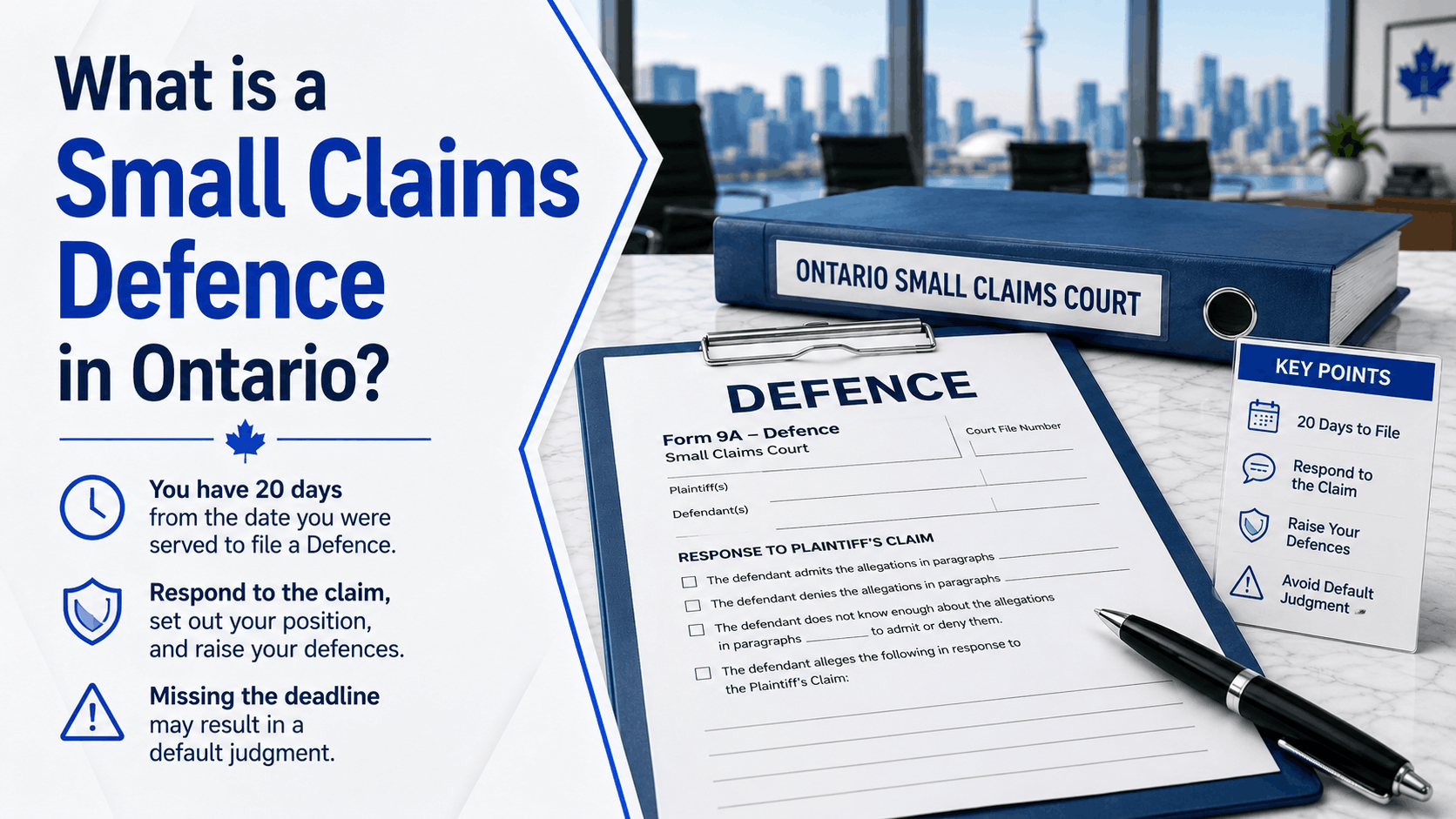
If you have been served with a Plaintiff’s Claim in Ontario Small Claims Court, you cannot simply ignore it. A Plaintiff’s Claim means someone has started a lawsuit against you. If you disagree with the claim, or even if you agree with only part of it, you usually need to respond by filing a Defence.
A Defence is the court document where you respond to the Plaintiff’s Claim. In Ontario Small Claims Court, the Defence is usually prepared using Form 9A. It tells the court and the plaintiff what parts of the claim you admit, what parts you deny, and why you say the plaintiff should not get everything they are asking for.
The deadline is very important. In Ontario Small Claims Court, you generally have 20 calendar days from the date you were served with the claim to serve and file your Defence. Ontario’s official Small Claims Court guide explains that after 20 days, the plaintiff can ask to have you noted in default.
Being noted in default is serious. It means the court records show that you did not defend the claim in time. If that happens, the plaintiff may be able to take further steps toward getting judgment against you without your side being properly heard. The Ontario Superior Court of Justice also explains that a defendant generally has 20 calendar days to serve and file a Defence, and that if a Defence is not filed in time, the plaintiff may ask the court to note the defendant in default.
A Defence is not just a short note saying, “I disagree.” It should clearly explain your position. If the plaintiff says you owe money under a contract, your Defence may need to explain why you do not owe the amount claimed. Maybe the work was not completed. Maybe the amount is wrong. Maybe you already paid. Maybe there was no agreement. Maybe the plaintiff breached the agreement first. The important point is that your Defence should help the court understand the real dispute.
A good Defence should respond to the main allegations in the Plaintiff’s Claim. If something is true, you may admit it. If something is false, you may deny it. If you do not know whether something is true, you can say that you do not have enough knowledge to admit it. The goal is to separate what is actually in dispute from what is not.
For example, if the Plaintiff’s Claim says there was a contract dated March 1, 2026, you may admit that a contract existed. But you may deny that you breached it. Or you may admit that money was paid, but deny that the plaintiff is entitled to a refund. A Defence does not have to deny everything. It should be accurate, careful, and focused.
The Defence can also raise legal defences. Depending on the case, you may argue that the claim was started too late, that the plaintiff sued the wrong person, that the contract was changed, that the plaintiff failed to mitigate their losses, that the amount claimed is unsupported, or that the plaintiff did not do what they were supposed to do. The right defence depends on the facts.
Sometimes, the defendant may also have a claim back against the plaintiff. This is called a Defendant’s Claim. It is different from a Defence. The Ontario Superior Court of Justice explains that a defendant’s claim is not the same as a Defence: in a defendant’s claim, the defendant is suing the plaintiff or another person, while in a Defence, the defendant responds to the allegations made in the claim.
This distinction matters. If you only want to explain why you should not have to pay the plaintiff, you may need a Defence. If you also want the court to order the plaintiff to pay you money, you may need to consider a Defendant’s Claim as well. These are different documents and should not be confused.
A Defence should also be organized. Small Claims Court is designed to be more accessible than higher court, but the court still needs to understand your position. A confusing Defence can make it harder for the judge, deputy judge, or settlement conference judge to see the strength of your case. It can also make it harder to negotiate a settlement.
Evidence is important, but the Defence itself is not the trial. You do not need to put every email, screenshot, receipt, photograph, or text message into the body of the Defence. However, your Defence should be based on the documents and facts you can actually support. If you make a statement in the Defence, you should be prepared to back it up later.
There may also be documents that should be attached or referred to, depending on the situation. For example, if the dispute is about a written contract, invoice, estimate, receipt, or other important document, it may need to be considered carefully when drafting the Defence. The Defence should not ignore documents that are central to the dispute.
Acting quickly is critical. Even if you think the claim is unfair, exaggerated, or completely wrong, you still need to deal with the deadline. If you miss the 20-day deadline, Ontario’s official guidance says you may still be able to file a Defence if the plaintiff has not yet asked the court to note you in default. But it is much safer to respond on time than to rely on fixing the problem later.
A Small Claims Defence can be used in many different types of cases. These may include unpaid invoices, loans, property damage, contractor disputes, defective work, refund claims, business disputes, consumer disputes, service disagreements, vehicle disputes, and contract claims. Each type of case may require a different kind of response.
For example, in a contractor dispute, the Defence may need to explain incomplete work, poor workmanship, delays, deficiencies, payments already made, or the cost to fix the work. In an unpaid invoice case, the Defence may need to explain why the invoice is wrong, why the service was not properly performed, or why the plaintiff is not entitled to the full amount. In a loan dispute, the Defence may need to address whether the money was actually a loan, whether it was repaid, or whether the amount claimed is accurate.
A Defence can also affect settlement. Once the plaintiff sees that you have filed a clear Defence, they may better understand that the case is disputed. This may lead to negotiation, a settlement conference, or a more realistic discussion about resolving the case. A weak or vague Defence may not have the same effect.
Flatly.ca offers a Small Claims Defence package in Ontario for people who have been served with a Plaintiff’s Claim and need help preparing a Defence. This can help you respond to the claim, set out your position, raise available defences, and avoid the serious risk of doing nothing.
A Plaintiff’s Claim is the start of the lawsuit, but the Defence is your opportunity to answer it. If you have been served, the most important thing is to act quickly. Missing the deadline can put you at risk of default. A properly drafted Defence helps protect your position and gives you a clearer path forward in the Small Claims Court process.
Legal Disclaimer
This article is for general information purposes only and does not constitute legal advice. It does not create a lawyer-client relationship. Laws and procedures may change. For advice specific to your situation, consult a licensed Ontario lawyer.
Need help with an Ontario legal matter?
Browse transparent flat-fee packages — know the cost before you commit.
Browse All Services