What is a Statement of Claim in Ontario Superior Court?
A Statement of Claim is one of the most important documents in a lawsuit. It starts the case, frames the issues, and tells the defendant what they must answer.
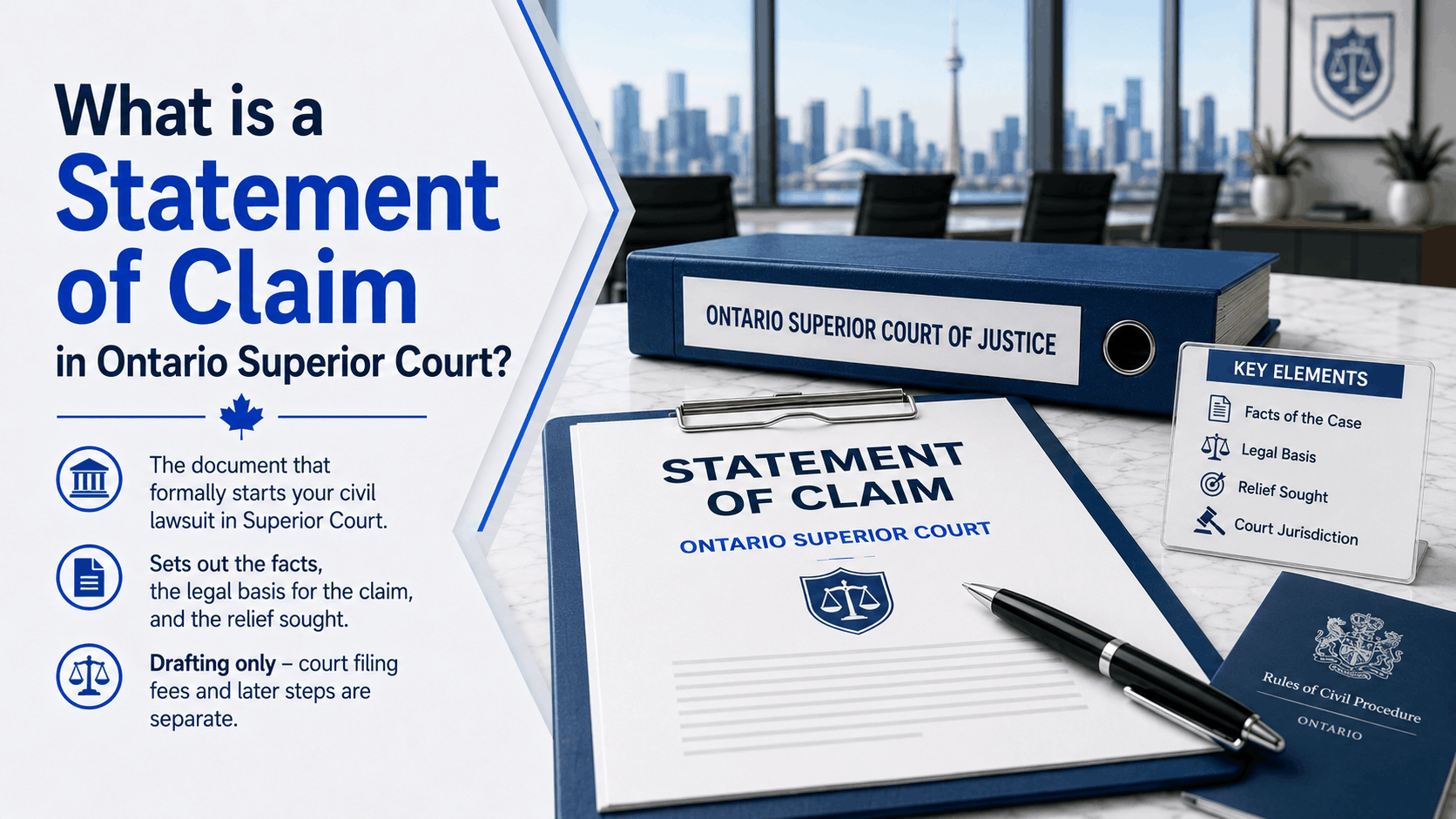
If you want to start a civil lawsuit in the Ontario Superior Court of Justice, the case usually begins with a document called a Statement of Claim, unless the value of the lawsuit is $50,000 or less, or if your case requires an "Application" instead of an "Action". We'll talk about Applications in a different article. For now, just keep in mind that a Statement of Claim is the document that formally tells the court and the defendant that you are suing, why you are suing, and what you want the court to order.
In simple terms, a Statement of Claim is the document that starts many civil lawsuits in Ontario Superior Court. The Ontario Superior Court of Justice explains that you can start a civil case by preparing and filing a Statement of Claim that describes the facts and legal reasons you are entitled to compensation. This type of case is called an “action.”
A Statement of Claim is different from a demand letter. A demand letter is usually sent before court. It warns the other side about the dispute and may ask them to pay money, stop doing something, or resolve the matter. A Statement of Claim is more serious because it begins the formal court process. Once it is issued and served, the defendant must decide how to respond.
The usual Ontario court form for a general Statement of Claim is Form 14A. Ontario Court Services lists Form 14A as the “Statement of Claim (General).” A typical Statement of Claim also requires a general heading and a backsheet, which means the document has to be prepared in the proper court format rather than simply written like an ordinary letter.
A well-drafted Statement of Claim should explain the important facts in a clear and organized way. It should identify the plaintiff, which is the person or business suing. It should identify the defendant, which is the person or business being sued. It should explain what happened, when it happened, how the defendant is connected to the problem, what legal basis supports the claim, and what remedy the plaintiff is asking for.
The “remedy” is what you want the court to order. This may include money damages, interest, costs, an injunction, a declaration, the return of property, or another form of relief. For example, if someone breached a contract and caused financial loss, the Statement of Claim may ask the court to order the defendant to pay damages. If someone is continuing harmful conduct, the claim may ask for an injunction to stop that conduct.
The facts matter. A Statement of Claim should not simply say, “The defendant treated me unfairly” or “The defendant owes me money.” It should explain the story in enough detail for the defendant to understand the case they have to meet. If the claim is about a contract, the document should usually explain who made the contract, what the important terms were, what the defendant failed to do, and what loss resulted. If the claim is about negligence, it should explain what duty was owed, what went wrong, and how the plaintiff was harmed.
At the same time, a Statement of Claim should not be a messy pile of every complaint, emotion, email, text message, or argument. It should be focused. The goal is to plead the material facts, not to include every piece of evidence. Evidence becomes important later in the lawsuit, but the Statement of Claim is mainly about setting out the case being advanced.
This distinction is important. A fact might be that the defendant failed to deliver goods by the agreed deadline. Evidence might include the contract, emails, invoices, delivery records, or photographs that help prove that fact. The Statement of Claim should usually focus on the key facts and legal basis for the claim, while the supporting evidence is dealt with later in the litigation process.
Ontario Superior Court is different from Small Claims Court. Small Claims Court handles many civil claims up to its monetary limit. Superior Court is used for larger claims and more complex matters. Ontario’s simplified procedure rules are also important because Ontario says that if you are suing for money or property valued up to $200,000 in the Superior Court of Justice, you must use the simplified procedure process rather than the ordinary procedure process.
Choosing the right court and procedure matters. If the claim is too small, Small Claims Court may be more practical. If the claim is too large or legally complex, Superior Court may be necessary. If the claim falls within simplified procedure, different rules may apply. These choices can affect cost, timing, strategy, and the steps that come after the claim is started.
A Statement of Claim also has to be drafted with the Rules of Civil Procedure in mind. The Ontario Superior Court of Justice explains that rules set out the practice and procedure that must be followed in court, including deadlines, timelines, court documents, forms, service, and filing. This means a Statement of Claim is not just a writing exercise. It is part of a formal legal process.
One common mistake is suing the wrong defendant. If you sue a person when the proper defendant is a corporation, or sue a trade name instead of the legal entity behind it, the case can become more complicated. Naming the correct defendant is especially important when dealing with businesses, contractors, landlords, employers, shareholders, or related companies.
Another common mistake is failing to clearly explain the legal basis for the claim. Different claims have different legal elements. A breach of contract claim is not the same as a negligence claim. A defamation claim is not the same as a shareholder oppression claim. A fraud claim is not the same as a simple unpaid invoice claim. A properly drafted Statement of Claim should match the facts to the right legal theory.
A poorly drafted Statement of Claim can create problems. It may cause confusion, invite procedural attacks, make settlement harder, or weaken the plaintiff’s position. In some cases, a claim that does not properly disclose a legal cause of action may be vulnerable to being struck. Even where the claim can be fixed later, amendments can create delay, cost, and frustration.
A good Statement of Claim can also help with settlement. When the defendant and their lawyer can clearly understand the facts, the legal basis for the claim, and the relief sought, they may be better able to assess risk. A clear claim does not guarantee settlement, but it can make the dispute more organized from the beginning.
It is also important to understand what Flatly’s service covers. Flatly.ca offers a Statement of Claim drafting package for Ontario Superior Court. This package covers drafting the Statement of Claim. Court filing fees and later steps in the lawsuit, such as filing, serving, motions, discoveries, settlement discussions, mediation, or trial, are separate.
A Statement of Claim is one of the most important documents in a civil lawsuit. It starts the case, frames the issues, and tells the defendant what they must answer. If you are preparing to sue in Ontario Superior Court, it is worth taking the drafting seriously. A clear and properly structured Statement of Claim can give your lawsuit a stronger foundation from the start.
Legal Disclaimer
This article is for general information purposes only and does not constitute legal advice. It does not create a lawyer-client relationship. Laws and procedures may change. For advice specific to your situation, consult a licensed Ontario lawyer.
Need help with an Ontario legal matter?
Browse transparent flat-fee packages — know the cost before you commit.
Browse All Services